- May 12, 2026
- Posted by: Tresmark
- Categories:
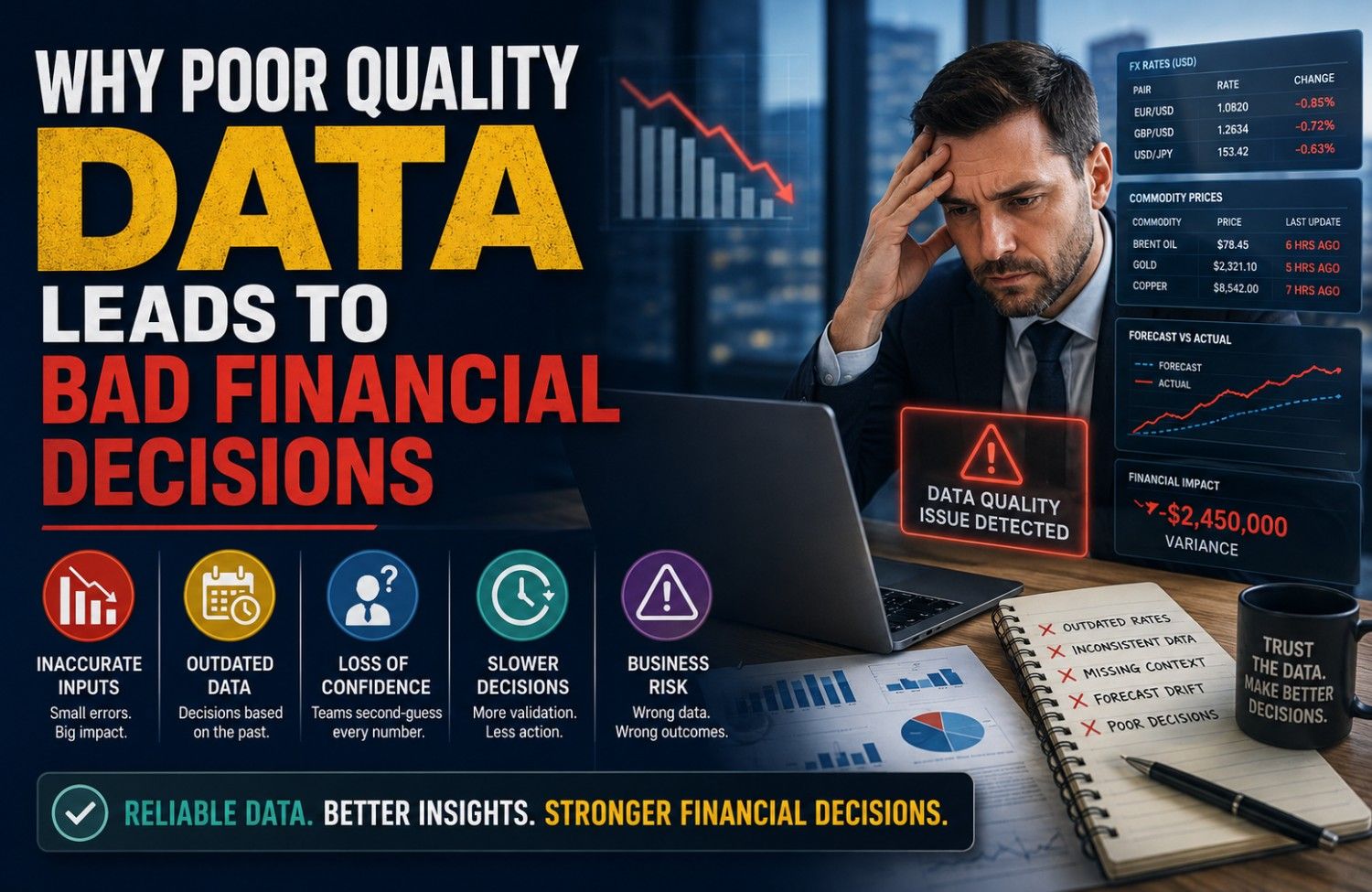
Why Poor Quality Data Leads to Bad Financial Decisions
Why Financial Decisions Depend on Reliable Data
Finance and treasury teams have more access to market data than ever before. Dashboards are faster, reporting is automated, and systems update continuously. But fast access does not guarantee reliable data.
A dashboard can still display outdated benchmarks, inconsistent market feeds, or pricing built on different methodologies.
The issue becomes critical during time-sensitive decisions. Treasury teams approving hedging positions or procurement teams negotiating supplier contracts usually act on what the system shows at that moment. If the underlying data is inaccurate or delayed, the decision may already be based on the wrong market view.
Poor quality financial data rarely looks broken. Reports generate normally, figures appear complete, and workflows continue without visible errors. The problem only appears later when outcomes no longer match expectations.
How Inaccurate Inputs Change Financial Interpretation
Small inaccuracies can create large financial impacts.
A minor variance in FX rates or commodity benchmarks may appear insignificant on its own, but across exposure calculations, forecasts, or procurement planning, the interpretation changes materially.
The bigger risk is consistent inaccuracy. When a system repeatedly delivers slightly incorrect data:
- Forecasting models adjust around it
- Planning assumptions drift over time
- Risk calculations become misaligned
- Pricing decisions lose accuracy
A commodity feed delayed by several hours still produces valid-looking numbers. The issue is that teams use those numbers as if they reflect current market conditions.
Unlike missing data, inaccurate data allows processes to continue while gradually pushing decisions in the wrong direction.
Why Forecasts Drift Without Obvious Errors
Forecasts often drift because the inputs stop reflecting current market conditions.
A treasury model built on exchange rates from several months earlier may continue generating reports normally even though the market has moved significantly. The calculations remain correct, but the assumptions behind them are outdated.
The same problem appears in procurement and commodity planning:
- Benchmark methodologies change
- Commodity prices update differently across providers
- Historical data revisions go unnoticed
- Market assumptions remain static while conditions shift
The result is a forecast that slowly loses alignment with reality without triggering any visible system error.
By that point the drift has usually been compounding for longer than anyone realizes. The source-level inconsistency that often triggers it is covered in how inconsistent market data compounds across systems.
How Poor Data Quality Changes Team Behavior
When teams stop trusting data fully, workflows begin changing around that uncertainty.
Analysts start manually verifying numbers before using them. Treasury checks exposure calculations independently. Finance managers add buffer assumptions into forecasts.
Over time, organizations build unofficial reconciliation layers into daily operations.
This creates operational friction such as:
- Analysts spending time validating inputs instead of analyzing markets
- Finance teams explaining variances rather than acting on insights
- Procurement and treasury using different benchmarks
- Leadership requiring additional sign-offs before decisions
The cost is not always visible in reports. It appears in slower decisions, repeated validation, and reduced confidence in financial reporting.
When Data Quality Starts Affecting Financial Decisions
At some stage, poor quality data stops being an operational issue and becomes a business risk.
Examples include:
- Treasury teams hedging exposure using outdated FX rates
- Procurement entering supplier negotiations with stale commodity benchmarks
- Finance leaders delaying forecasts due to inconsistent reporting inputs
- Management questioning whether reports are comparable across periods
The issue is rarely the absence of data. It is the inability to trust whether the data reflects current market conditions accurately.
Reliable financial data infrastructure reduces that uncertainty by keeping treasury, procurement, and finance teams aligned on the same market view.
What Reliable Data Changes in Financial Operations
Reliable market and financial data changes how decisions move through the organization.
When inputs are accurate and consistent:
- Forecasts require fewer buffer assumptions
- Treasury reports align across systems
- Sign-off processes become faster
- Audit trails improve
- Teams spend less time reconciling figures
The focus shifts away from validating numbers and toward responding to market conditions.
Analysts gain confidence in their reporting, treasury teams improve exposure visibility, and leadership can act without waiting for multiple rounds of verification.
Final Perspective: Reliable Data Improves Decision-Making
Financial decisions are only as strong as the data behind them.
Poor quality data creates forecasting drift, reporting inconsistencies, operational delays, and weaker financial visibility. The impact usually appears gradually through repeated validation, slower workflows, and reduced confidence in reports.
Reliable market data infrastructure improves financial decision-making by ensuring treasury, finance, and procurement teams work from accurate, consistent, and timely information.