- May 9, 2026
- Posted by: Tresmark
- Categories:
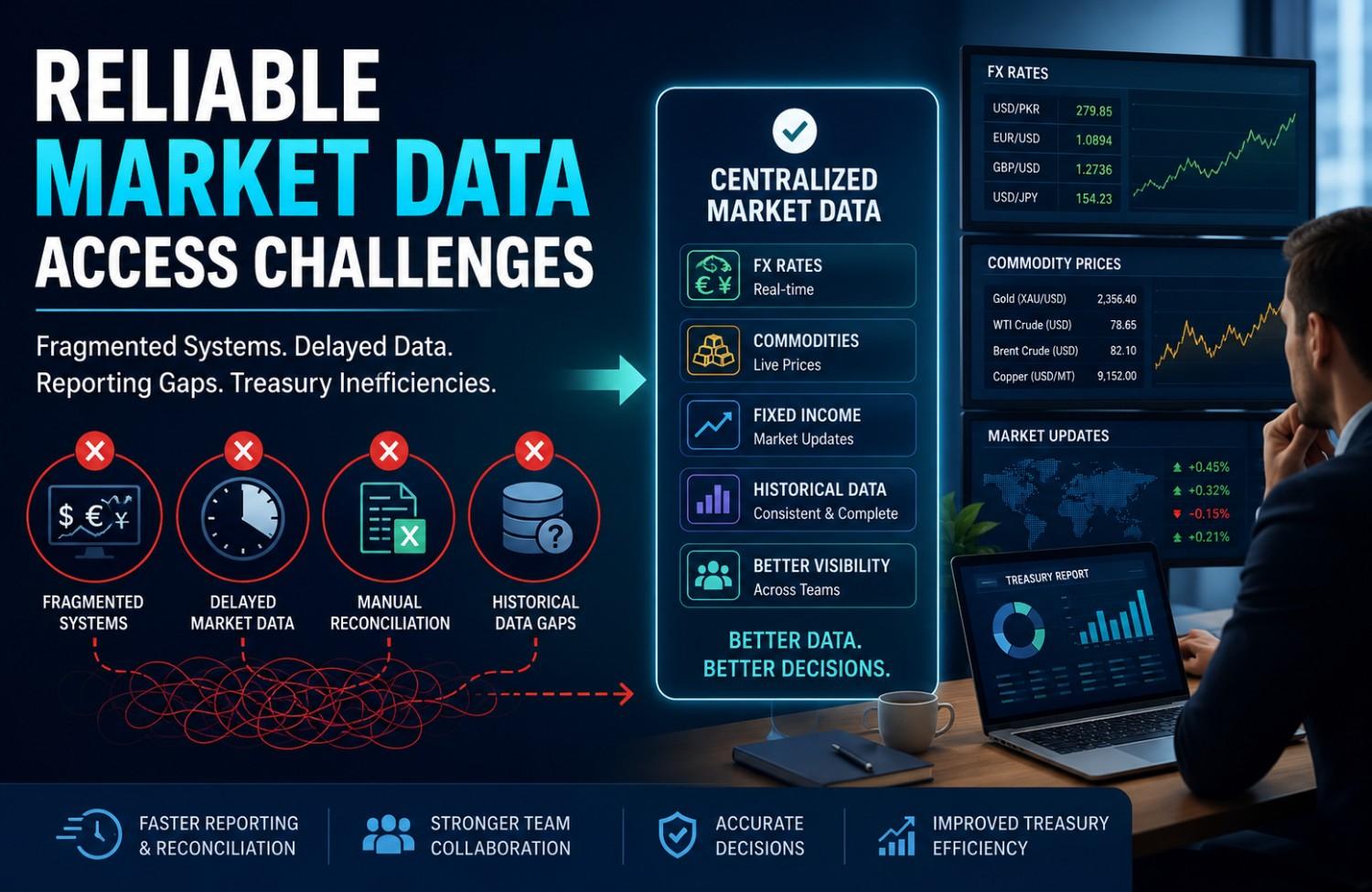
Common Challenges in Accessing Reliable Market Data
Why Market Data Access Becomes Difficult
Market data access is manageable when teams use a single platform. The challenge begins as treasury, finance, procurement, and dealing functions expand across multiple systems.
FX rates may come from one platform, commodity prices from another, and historical data from spreadsheets or vendor exports. Over time, information becomes fragmented, making it harder to access reliable market data quickly and consistently.
For banks, corporates, and treasury teams, this creates reporting delays, visibility gaps, and operational inefficiencies.
How Fragmented Systems Reduce Treasury Visibility
Most organizations do not intentionally create fragmented workflows. Different teams adopt different data sources over time.
Treasury dealers may track USD/PKR on one platform, commodities on another, and confirmations through spreadsheets or other means. The result is constant switching between systems just to verify market conditions.
This leads to:
- Repeated checking of FX and commodity prices
- Different refresh timings across platforms
- Delays in treasury reporting and reconciliation
- Limited visibility across departments
Instead of working from one reliable source, teams rely on multiple disconnected views of the market.
How Delayed Market Data Impacts Reporting
Access to market data does not always mean access to current market conditions.
A treasury report may use FX rates captured hours earlier, while commodity prices used for procurement planning may already be outdated. Reports remain technically correct, but no longer reflect the live market.
The delay usually builds across workflows:
- Data feeds refresh late
- Platforms update at different times
- Reports require manual exports and validation
- Decision-makers receive outdated information
Over time, teams spend more effort confirming data than using it.
Why Manual Reconciliation Becomes Routine
Fragmented market data environments increase manual work.
Treasury and finance teams repeatedly compare rates, reports, and positions across systems before making decisions. The same figures are checked multiple times because updates do not remain aligned.
Common issues include:
- FX rates differing across platforms
- Commodity benchmarks updating inconsistently
- Historical data gaps between vendors
- Treasury positions requiring repeated validation
The effort comes from keeping information aligned rather than from the analysis itself.
When Historical Data Creates Problems
Historical market data is essential for budgeting, forecasting, and exposure analysis. Problems appear when historical coverage comes from inconsistent sources.
Organizations often face:
- Missing historical records
- Inconsistent vendor methodologies
- Different exchange coverage over time
- Historical exports that do not match current feeds
These gaps reduce confidence in long-term analysis and reporting.
How Centralized Market Data Improves Operations
Centralized market data reduces fragmentation by bringing FX, commodities, fixed income, and market updates into one platform.
This improves:
- Treasury visibility across currencies and exposures
- Real-time access to USD/PKR and commodity prices
- Faster reporting and reconciliation
- Better coordination between treasury, finance, and procurement teams
- Consistent financial market data across workflows
When systems remain aligned, teams spend less time validating information and more time making decisions.
Reliable access to centralized market data and financial data integration helps organizations improve reporting accuracy and operational efficiency across treasury workflows.
Final Perspective: Better Access Improves Decisions
The challenge is rarely the absence of market data. The real issue is accessing reliable, current, and consistent information across multiple systems.
As treasury operations grow, fragmented data creates delays, repeated validation, and reporting inefficiencies.
Centralized and reliable market data infrastructure helps teams move faster, improve visibility, and make decisions with greater confidence.