- June 4, 2026
- Posted by: Tresmark
- Categories:
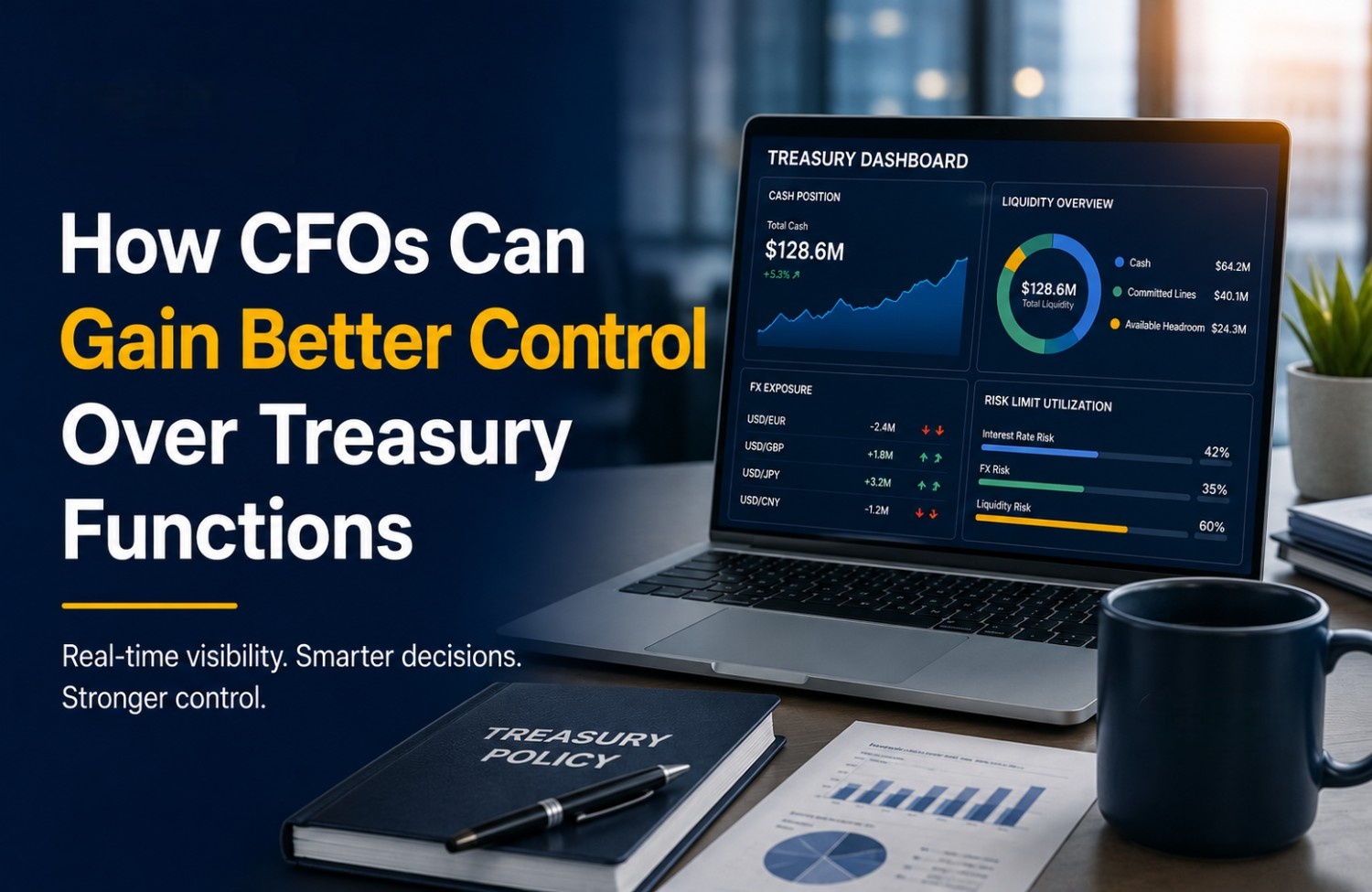
The Difference Between Overseeing Treasury and Trusting It
Most CFOs with a dedicated treasury function have signed a treasury policy, approved a set of risk limits, and receive regular summaries confirming that operations are within those limits. On paper, that is oversight. In practice, it is something closer to informed delegation, a governance arrangement that functions on the assumption that what the treasury function reports between its review cycles accurately reflects what is actually happening within them.
That assumption is not always wrong.
But it is not the same as control. A CFO who receives a weekly treasury summary knows what the function looked like at the point the summary was produced. They do not necessarily know what it looks like now, whether exposures have shifted materially since the last consolidation, or whether a developing liquidity or FX situation has crossed a threshold that would ordinarily warrant escalation. The report confirms a past state. The CFO’s oversight of the present state depends on whether the data infrastructure behind that report is capable of surfacing the present state at all.
Real-time data feeds and structured treasury capabilities emerged as a competitive differentiator in 2025, with their absence shining a light on the technical debt gaps accumulating within existing finance stacks. The gap those findings reveal is not primarily a technology problem. When a CFO’s oversight of the treasury function depends on what periodic reporting chooses to surface, the control they believe they have is only as reliable as the reporting cycle that delivers it.
What CFO Treasury Oversight Actually Requires
Treasury policy frameworks are usually well-designed. Policy documents define what the function is authorized to do, what risk limits apply, and under what conditions decisions must be escalated to the CFO or the board. Most treasury functions operate within those limits most of the time. Compliance confirmations that reach the CFO reflect genuine adherence. The problem is not the framework. It is the visibility gap between what the framework requires and what the CFO can independently verify between reporting cycles.
Delegated trust means the CFO has confidence in the function based on its track record, its reporting, and its compliance history. That confidence is earned and reasonable. Genuine oversight means the CFO can verify, not on the basis of trust but on the basis of current data, whether the treasury function is operating within its mandate at any given moment. Most CFOs operate in the first condition. Governance accountability at the CFO level requires the second, particularly when conditions shift quickly and the relevant question is not whether treasury was compliant last week but whether it is compliant now.
Boundary conditions are where the gap becomes most operationally visible. When market conditions are moving, exposure limits are being approached, or liquidity headroom is tightening, the reporting structure that works adequately in stable conditions can leave a developing treasury situation invisible to CFO-level oversight until it has moved past the point where early intervention would have been most effective. Treasury policy is designed as a mechanism for delegating financial decisions in a controlled manner, with the treasurer referring decisions back to the CFO or board when they exceed delegated authority. That referral mechanism depends on the treasurer recognizing and escalating the issue. When the data infrastructure behind operations does not surface developing situations in real time, the escalation pathway depends on manual judgment applied to periodic data, which is a different quality of governance control than one supported by continuous visibility. The operational conditions that create this gap are examined in our piece on the role of treasury in financial risk management.
Why Treasury Reporting Rarely Gives CFOs Genuine Control
A treasury performance summary looks like oversight. It covers positions, exposures, compliance status, and cash availability across the function’s key responsibilities. Produced by professionals who understand what the CFO needs to see, it is structured to confirm that operations are within policy. What it cannot do, regardless of how well it is prepared, is describe conditions that came into existence after it was produced. The moment a treasury summary leaves the function, it begins aging. By the time it reaches the CFO, reviewed and acted upon, the conditions it describes may have shifted in ways the document cannot reflect.
Between one weekly summary and the next is where the reporting quality gap lives. Commodity prices move. FX rates shift. Intraday facility draws change the liquidity picture. A counterparty payment delays in a way that affects short-term cash availability. A covenant calculation that was comfortably within limits on Monday may be closer to the boundary by Thursday. None of those movements trigger an automatic update to the CFO’s picture of treasury performance. They accumulate silently until the next reporting cycle captures them, by which point the week’s oversight has been retrospective rather than current throughout.
That structural problem is not a reflection of reporting quality. It reflects the frequency and currency of the data behind the report. 97% of CFOs rank cash and liquidity management among their top priorities, yet many face ongoing challenges around limited visibility into cash flow. Those visibility challenges reflect the architecture of reporting systems built to produce accurate historical summaries rather than current oversight pictures. A CFO relying on weekly summaries is not receiving less capable reporting than one with real-time visibility. They are receiving a fundamentally different quality of governance information, one that describes the past accurately and the present not at all.
How Current Treasury Data Changes CFO Oversight
Real-time visibility into treasury performance does not change what the CFO is responsible for. Risk limits, policy frameworks, escalation thresholds, and governance mandates remain exactly as they were. What changes is whether the CFO can exercise that mandate continuously rather than periodically, whether oversight is something that happens between reporting cycles as well as at them.
Between-cycle visibility is the most immediate change. When treasury data consolidates continuously rather than at defined reporting intervals, the CFO’s view of performance is not a series of weekly snapshots separated by periods of darkness. Cash positions, FX exposure levels, facility headroom, and covenant calculations are visible as they move rather than as they stood when the last summary was produced. A covenant approaching its limit on a Wednesday is visible to the CFO on Wednesday, not in the Friday summary describing where it was at week’s end. A liquidity picture that shifted following an intraday facility draw is current rather than pending the next consolidation cycle. The oversight gap does not close entirely; markets will always move faster than any reporting architecture, but the period during which the CFO is working from conditions that have already changed compresses significantly.
Escalation changes in a related way. When performance is visible continuously, the threshold for escalation no longer depends on whether the treasurer has identified and flagged a developing situation before the next reporting cycle. The CFO can see developing conditions directly, shifting the escalation conversation from retrospective notification to prospective discussion. Rather than learning that a covenant was breached or a liquidity threshold was approached after the fact, the CFO sees the trajectory before it becomes a consequence. PwC 2025 confirms treasury must lead with real-time visibility and centralized control as economic volatility intensifies the spotlight on financial risk. That centralized control means having a data picture that makes genuine governance oversight possible rather than oversight that depends on what the reporting cycle chooses to surface.
Real-time treasury visibility enables four specific CFO oversight capabilities:
- Continuous covenant monitoring: covenant calculations reflect current position data rather than end-of-period snapshots, giving the CFO visibility into headroom levels as market conditions and facility draws affect them throughout the reporting cycle
- Current FX exposure picture: currency exposure levels update as entity positions change, allowing the CFO to see the group’s FX profile at any point rather than at the last consolidation
- Live liquidity tracking: cash positions, facility availability, and intercompany balances reflect intraday movements rather than prior-cycle figures, giving the CFO a current picture of liquidity across the function
- Proactive escalation capability: developing situations, approaching risk limits, and threshold movements are visible before they become reportable events, shifting the governance dynamic from reactive notification to continuous oversight
The data infrastructure that supports this kind of continuous visibility is examined in our piece on how centralized data improves treasury.
What Genuine Treasury Oversight Means for Organizational Governance
Genuine real-time visibility into treasury performance changes what the CFO brings to the board and audit committee. They are no longer relaying what treasury reported. They are confirming what they can independently verify. That distinction matters most precisely when governance scrutiny is highest, when market conditions are volatile, when audit committee questions are pointed, and when the organization’s financial position is under external pressure.
Audit committees test the quality of financial oversight, not just financial performance. A CFO answering a pointed question about current FX exposure, covenant headroom, or liquidity from verified current data occupies a different governance position than one answering from the most recent treasury summary qualified with a data currency caveat. Both may be describing accurate information. The governance difference is in the ability to confirm rather than relay. Finance is being reconfigured for speed, visibility, and cross-functional decision-making, with functions that were once siloed now requiring tighter coordination to keep pace with strategic demands. The CFO who can confirm current treasury performance rather than relay reported performance is operating at a different level of that coordination.
Organizational trust changes in a specific way when both treasury and the CFO are working from the same live picture. Treasury is not producing reports for the CFO to review on trust. The CFO is not asking the function to confirm positions that may have moved since the last summary. Both share a current view of the same reality, shifting the governance relationship from a reporting dynamic to a monitoring dynamic. The CFO’s awareness of treasury performance is no longer contingent on what the reporting cycle delivers. It reflects what the function is actually doing at any given moment. How that real-time visibility translates into better financial decisions at the leadership level is examined in our piece on how real-time visibility helps leadership make better financial decisions.
From Delegated Trust to Genuine Treasury Control
Treasury governance does not fall short because CFOs are inattentive or because treasury functions perform below their mandate. It operates below its potential because the data infrastructure behind treasury reporting was designed to confirm past performance rather than surface current conditions. A CFO who reviews a complete, accurate, well-prepared summary every week is exercising governance within the constraints of what periodic reporting can deliver. Those constraints are significant, and they are structural rather than personal.
Genuine control requires something the governance framework alone cannot provide: visibility into current conditions between the reporting cycles that the framework defines. Not to replace the treasurer’s operational judgment or override the function’s autonomy, but to give the CFO what oversight accountability actually requires, the ability to see the function’s current performance against its mandate rather than its most recently reported performance against it. PwC 2025 confirms treasury must lead with real-time visibility and centralized control as economic volatility intensifies pressure on financial risk management. Delivering against that mandate requires the CFO to see it being met, not simply be told it is.
Real-time treasury visibility delivers four things to the CFO oversight function:
- Continuous performance monitoring: treasury performance against risk limits, policy thresholds, and covenant requirements is visible throughout the reporting cycle rather than confirmed at its close, giving the CFO an oversight picture that reflects current conditions rather than historical snapshots
- Independent verification capability: the CFO can confirm current treasury positions directly from the data rather than from what the treasury function has chosen to include in its most recent summary, changing the governance relationship from trust-based to evidence-based
- Proactive governance posture: developing situations, approaching thresholds, and between-cycle movements are visible before they become reportable events, allowing the CFO to engage prospectively rather than respond retrospectively
- Audit and board confidence: when CFOs answer governance questions from current verified data rather than the most recent summary, the quality of the governance conversation with the board and audit committee reflects the actual state of the function
Treasury functions that operate with this level of CFO visibility are not more constrained than those that do not. They are more clearly understood, and a function that is clearly understood by its CFO is operating in a governance environment that supports both its performance and its accountability.
Tresmark’s treasury market data and visibility platform provides real-time visibility into market rates, FX movements, benchmark data, and treasury-relevant information, helping CFOs and treasury teams monitor exposures, liquidity conditions, and financial risks with greater confidence.