- June 15, 2026
- Posted by: Tresmark
- Categories:
The Two Market Data Categories That Drive Treasury Operations
Every working day in a corporate treasury function begins with rates. Spot rates pulled to revalue overnight positions. Forward rate curves checked against the coverage assessments built the previous day. Money market benchmarks reviewed before short-term investment decisions are confirmed. The sequence is routine enough that the data behind it rarely gets examined as infrastructure. It is simply the information the day starts with, assumed to be current, assumed to be consistent, assumed to cover the currency pairs and tenors the function needs.
Those assumptions are not always justified.
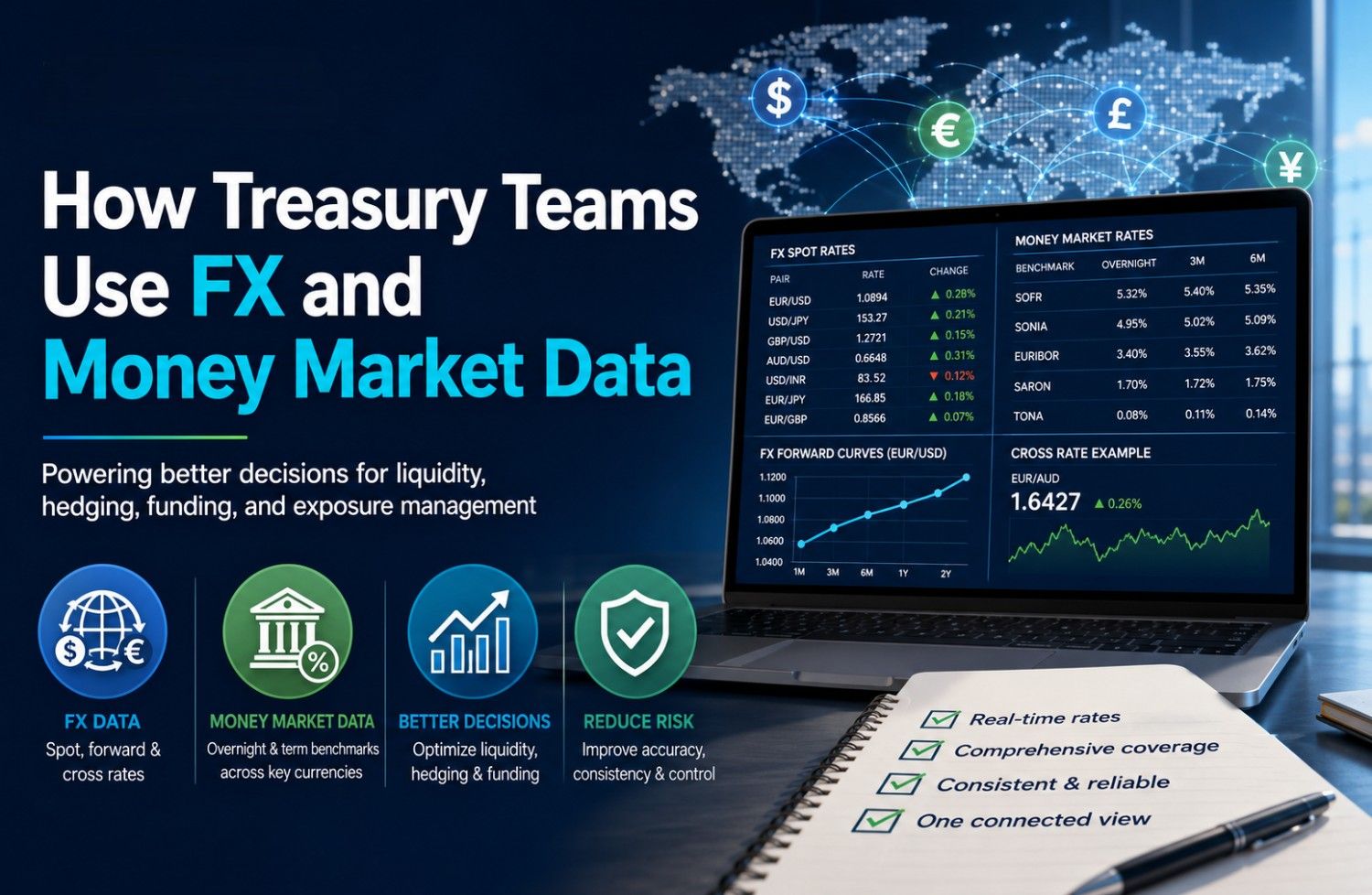
FX rate data and money market rate data are the two market data categories that corporate treasury teams depend on most directly for daily operational decisions. Not as background context, not as periodic reference, but as the live inputs that determine whether an exposure assessment reflects current market conditions, whether a short-term investment return is benchmarked against a rate that is still accurate, and whether a banking counterparty quote can be evaluated against an independent market reference. Both categories have specific data type requirements, specific update frequency requirements, and specific coverage requirements. When any of those requirements is not met, specific treasury workflows produce outputs that do not reflect the market conditions they are supposed to describe.
What FX Rate Data Treasury Teams Actually Need
Treasury operations rarely depend on just one FX rate. Different rates are used for funding, hedging, reporting, and valuation, often with different update schedules and source requirements. Treating them as equivalent can introduce inconsistencies long before anyone notices a problem in the numbers.
Spot rates are the most frequently used and the most frequently assumed to be adequate. Every day, treasury teams use spot rates to revalue open currency positions, process multicurrency payments at current market levels, and update the FX exposure picture that feeds into the consolidated group exposure report. Spot rates need to reflect the market at the moment they are used rather than at some prior point in the trading session. A rate that is twenty minutes old in a moving market is not a minor discrepancy. It is a revaluation built on conditions that have already changed, a payment processed at a price the market has moved through, a group exposure report describing a position that no longer exists at the value it shows. When treasury teams pull spot rates from a system that caches at intervals rather than updating continuously, the revaluation, payment, and exposure reporting workflows all operate on data that is structurally behind the market.
Forward rates carry a different requirement. Spot rates need to be current. Forward rates need to be consistent, reflecting the same underlying market conditions across the currency pairs and tenors a treasury function monitors. Forward rates serve exposure assessment models and coverage cost evaluations across different forward periods. When forward rate data is inconsistent across currency pairs because different pairs are sourced from providers with different update schedules, the coverage assessment carries an internal inconsistency the model does not flag. A treasury team comparing the cost of managing a six-month euro exposure against a six-month sterling exposure using forward rates from two sources current at different moments is not comparing like with like, even when the model makes it appear that way.
Cross rates represent the most practically disruptive FX data gap for treasury functions managing positions across multiple currencies. A cross rate is the exchange rate between two currencies neither of which is the US dollar: euro to Australian dollar, sterling to Japanese yen, Swiss franc to Singapore dollar. Many treasury management systems carry direct spot and forward rates only for major dollar pairs, requiring cross rates to be calculated through intermediate dollar legs. When a treasury analyst needs the current euro-to-Australian-dollar rate to revalue an intercompany position and the system does not carry it directly, the calculation requires pulling two dollar rates, applying the arithmetic, and accepting that the resulting cross rate reflects the market at two separate moments rather than one. For treasury functions managing significant cross-currency positions across multiple operating entities, the cumulative inaccuracy of manually calculated cross rates is not a rounding problem. It is a gap in the exposure picture the function is operating from. The multi-entity FX exposure consolidation challenge this creates is examined in our piece on the role of treasury in financial risk management.
How Treasury Teams Use Money Market Rate Data
Money market rate data serves a different operational purpose in treasury than FX rate data but carries the same requirement for accuracy and timeliness. While FX rates support exposure monitoring and currency risk management, money market rates guide liquidity deployment and short-term funding decisions. Together, these datasets help treasury teams optimize cash utilization and funding costs across the organization.
Overnight benchmark rates form the foundation of money market intelligence for corporate treasury. Benchmarks such as SOFR (Secured Overnight Financing Rate) in the United States, SONIA (Sterling Overnight Index Average) in the United Kingdom, and EURIBOR in the Eurozone provide market-based reference rates for short-term borrowing and lending activity. Treasury teams use these benchmarks to evaluate overnight investment opportunities, assess funding costs, and monitor liquidity conditions across multiple currencies. Because these rates move in response to monetary policy and market liquidity conditions, access to current and reliable benchmark data is critical. Decisions made using outdated rates can lead to inaccurate assessments of funding costs or investment returns.
Term rates extend this analysis across longer short-term horizons. One-month, three-month, and six-month benchmark rates provide treasury teams with a reference point for evaluating deposits, money market instruments, and short-term financing opportunities. A treasury function deploying surplus cash for several months needs to know whether the return offered by a banking counterparty reflects prevailing market conditions or whether more competitive alternatives are available. Independent access to current term rate data allows treasury teams to compare opportunities objectively rather than relying solely on counterparty quotations. Without this benchmark context, organizations risk earning below-market returns on surplus liquidity or accepting funding costs that are not aligned with prevailing market conditions.
Why Treasury Needs Both Data Categories in the Same Picture
Historically, FX rate data and money market rate data have been organized and distributed separately. FX rates from currency markets. Money market rates from interest rate markets. Different sources, different providers, different update schedules. Most treasury management systems reflect that separation, presenting FX rates in one module and money market benchmarks in another, each drawing from its own data feed on its own timeline. The practical consequence is a treasury function monitoring two connected market variables in two disconnected environments, where the relationship between them is never visible as a single picture at the moment it matters most.
Carry is where the connection becomes most operationally concrete. When a treasury team decides where to deploy surplus cash across multiple currencies, the relevant question is not just what money market rate is available in each currency. It is what money market rate is available relative to the cost of holding that currency. A three-month SOFR-linked investment in US dollars returns differently from a three-month SONIA-linked investment in sterling when the spot rate between the two currencies is moving. If the dollar strengthens against sterling during the investment period, the sterling investment’s return in dollar terms is eroded by the FX move even if the nominal SONIA rate looked competitive when the decision was made. Assessing the money market rate without simultaneously assessing the FX rate trajectory produces a decision built on half the relevant information. One market informs the decision. Two markets determine the return.
FX forward rates carry the same dependency in the opposite direction. Forward rates between two currencies embed the interest rate differential for the same tenor, so when the money market rate environment shifts, forward rates move with it. When a treasury team assesses the cost of managing a forward FX exposure and overnight benchmarks have moved since the forward rate was last quoted, following a central bank communication, a significant data release, or a liquidity event in the short-term funding market, the apparent coverage cost may not reflect current conditions. The forward rate in the TMS reflects yesterday’s interest rate differential. The coverage assessment built on it begins with data that is already stale. How macroeconomic rate decisions interact with both FX rates and money market rates to compound these movements is examined in the relationship between interest rates and commodities.
Managing this connection operationally requires FX rates and money market rates accessible in the same data environment at the same moment. Not as separate modules accessed in sequence, not as figures pulled from different sources and reconciled manually, but as a connected picture reflecting the current relationship between currency rates and interest rate differentials across the currencies and tenors the treasury function manages. The data infrastructure that makes this kind of integrated visibility possible is examined in how centralized data improves treasury efficiency.
What FX and Money Market Data Quality Requires
Three data quality dimensions determine whether FX and money market rate data supports reliable treasury outputs. They correspond directly to the three assumptions the morning workflow makes without examining them: that the data is current, that it covers the right currency pairs and benchmarks, and that it is consistent across the sources the function depends on. When any of the three is not met, treasury workflows produce outputs describing market conditions that no longer exist.
Update frequency is the most immediately visible dimension. A treasury function working with FX spot rates updating every fifteen minutes operates with rates already historical in a market moving continuously. A money market benchmark from the previous session is not a current rate. It is yesterday’s market presented as today’s. The data quality problem is invisible in stable conditions and most acute in volatile ones, which means it matters most precisely when it is hardest to detect. When markets are moving quickly, when counterparty quotes need evaluating urgently, when an exposure revaluation is needed before a coverage decision, the gap between the last update and current conditions is at its widest. APIs now replace batch processing, providing instant access to balances, FX rates, and transaction status as real-time treasury moves from strategic aspiration to operational standard. Continuous data delivery is not a technology preference. It is the infrastructure condition under which rate data can actually be current.
Coverage breadth is the second dimension. A treasury function monitoring exposure across twenty currency pairs needs rate data for all twenty, not just the eight or ten a standard provider covers comprehensively. The pairs that matter most to a specific treasury function are not always the most liquid in the global FX market. A manufacturing business with operations in Central Europe, Southeast Asia, and Latin America carries significant exposure in currency pairs less well-served by generic market data feeds than the major dollar, euro, and sterling pairs. When coverage gaps leave specific pairs unmonitored or require manual calculation through intermediate legs, the exposure picture has structural gaps the function may not be able to see from inside its own systems. The same applies to money market benchmarks: a function operating across multiple currency zones needs current benchmarks for each relevant rate environment, not just SOFR for dollar positions.
Consistency across sources is the third dimension and the least visible. When rate data for the same currency pair comes from different providers, one source feeding the TMS, another used for manual checks, a third available through the banking portal, the rates will not always agree. The discrepancy may be small in absolute terms and consequential when it feeds into an exposure assessment or a coverage cost evaluation. A treasury team reconciling rate discrepancies as a routine part of daily workflow has normalized a data quality problem into an operational overhead. The reconciliation produces no analytical value. It compensates for an infrastructure gap that consistent, single-source rate data would eliminate. How FX data quality connects to financial performance outcomes is examined in how treasury functions impact financial performance. How the same data consistency standards determine forecast quality is examined in how financial data platforms support better forecasting.
FX and money market data infrastructure requirements for corporate treasury:
- Real-time rate delivery: FX spot rates and money market benchmarks update continuously rather than at batch intervals, reflecting current market conditions at the moment treasury decisions are made rather than conditions from the last update cycle
- Comprehensive currency pair coverage: direct rate coverage across the full set of currency pairs a treasury function monitors, including cross rates for non-dollar pairs, eliminating manual intermediate calculations and the timing gaps they introduce
- Consistent benchmark sourcing: FX rates and money market benchmarks sourced from a single consistent environment rather than multiple providers with different update schedules and rate construction methodologies, removing the reconciliation overhead that multi-source rate data creates
- Multi-benchmark money market coverage: current overnight and term rate data across SOFR, SONIA, EURIBOR, and regional equivalents, giving treasury teams a consistent rate context for short-term investment and borrowing decisions across all currency zones they operate in
FX and Money Market Data as Treasury’s Market Intelligence Foundation
Every treasury decision touching currency or short-term liquidity depends on rate data. Not occasionally, not as background context, but as the direct input determining whether an exposure assessment, an investment evaluation, or a coverage decision reflects current market conditions or a recent approximation of them. The quality of that input is not a technology question. It is the operational foundation on which daily treasury outputs rest, determined upstream of every workflow that depends on them.
Spot rates, forward curves, overnight benchmarks, and cross-rate coverage are not sophisticated capabilities. They are the baseline conditions under which a treasury function produces outputs that describe the market as it currently exists rather than as it existed when the data was last updated. Most corporate treasury functions operate somewhere between that baseline and an adequate infrastructure to support it, often without a clear picture of exactly where the gap sits or which specific workflows it is affecting. The macro signals that move both FX rates and money market benchmarks can be monitored as part of the same connected market intelligence picture, as examined in what economic indicators are and how they affect markets.
Connected FX and money market data coverage delivers four specific capabilities:
- Current exposure assessment: spot and forward rates reflecting present conditions give exposure calculations a basis matching the market at the point the assessment is made rather than when the data was last refreshed
- Competitive rate benchmarking: current overnight and term money market benchmarks across all relevant currency zones give treasury teams an independent reference against which counterparty quotes can be evaluated rather than accepted on relationship or convention
- Integrated carry visibility: FX rates and money market rates accessible in the same environment simultaneously allow treasury teams to assess short-term liquidity deployment against the full picture of currency and rate market conditions rather than one dimension at a time
- Consistent cross-rate coverage: direct rate data for the full set of currency pairs a treasury function monitors removes the manual calculation overhead and timing gaps that indirect cross-rate construction introduces
Rate data is where treasury market intelligence begins. When the morning sequence works as it should, when spot rates are current, forward curves consistent, money market benchmarks reflect today’s market, and cross-rate coverage extends to every pair the function monitors, daily treasury outputs describe the financial position the organization actually holds. When any element of that sequence is working from data that has already aged, the outputs describe something slightly different: a position that existed at some prior moment, assessed against conditions that have since moved on.
Tresmark’s treasury and market data platform gives treasury teams real-time access to FX spot and forward rates, money market benchmarks, and cross-rate coverage across multiple currency pairs and data sources, providing the connected rate data environment that daily treasury operations require.