
- January 22, 2026
- Posted by: Tresmark
- Category:
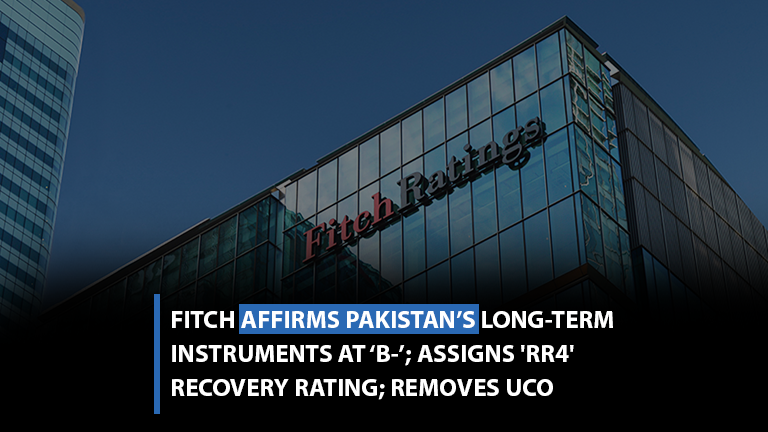
Fitch Ratings has affirmed Pakistan’s long-term debt ratings at ‘B-‘ and assigned a Recovery Rating of ‘RR4‘ following the removal of the ratings from Under Criteria Observation (UCO). The rating actions reflect the application of Fitch’s new Sovereign Rating Criteria, effective September 2025, and the inclusion of recovery assumptions into sovereign debt ratings for the first time.
A full list of rating actions is at the end of this rating action commentary.
Key Rating Drivers
The senior unsecured long-term debt ratings of Pakistan and The Pakistan Global Sukuk Programme Company Limited are equalised with Pakistan’s Long-Term Foreign-Currency Issuer Default Rating (IDR), reflecting Fitch’s expectation of average recovery prospects in a default scenario, given Pakistan’s high levels of general government debt and interest payments as a percentage of revenue, and the absence of any other clearly identifiable criteria factors that would cause us to notch the debt ratings up or down from the IDR.
On 15 April 2025, Fitch upgraded Pakistan’s Long-Term Foreign-Currency IDR to ‘B-‘ with a Stable Outlook, from ‘CCC+’.
The following environmental, social, and governance (ESG) issues represent key rating drivers for the Long-Term Foreign-Currency IDR and, in turn, the debt ratings.
ESG – Governance: Pakistan has an ESG Relevance Score of ‘5’ for political stability and rights and for the rule of law, institutional and regulatory quality and control of corruption, as is the case for all sovereigns. These scores reflect the high weight that World Bank Governance Indicators (WBGI) have in our proprietary Sovereign Rating Model. Pakistan has a WBGI ranking at the 22nd percentile.
The bond and sukuk ratings are sensitive to any changes in Pakistan’s Long-Term Foreign-Currency IDR, which has the following rating sensitivities (as per the rating action commentary referenced above).
RATING SENSITIVITIES
Factors that Could, Individually or Collectively, Lead to Negative Rating Action/Downgrade
– Public Finances: Failure to keep government debt and debt-servicing metrics on a firm downward path.
– External Finances: Renewed deterioration in external liquidity conditions, for example from delays in IMF programme reviews or insufficiently tight economic policy settings.
Factors that Could, Individually or Collectively, Lead to Positive Rating Action/Upgrade
– Public Finances: Significant declines in government debt and debt-servicing burdens, for example due to the implementation of fiscal consolidation plans in line with IMF programme commitments, leading to structural improvements in tax revenue generation.
– External Finances: Further significant easing of external financing risks, including evidence of greater ability to source external funding and a sustained recovery in foreign-currency reserves beyond Fitch’s forecasts.
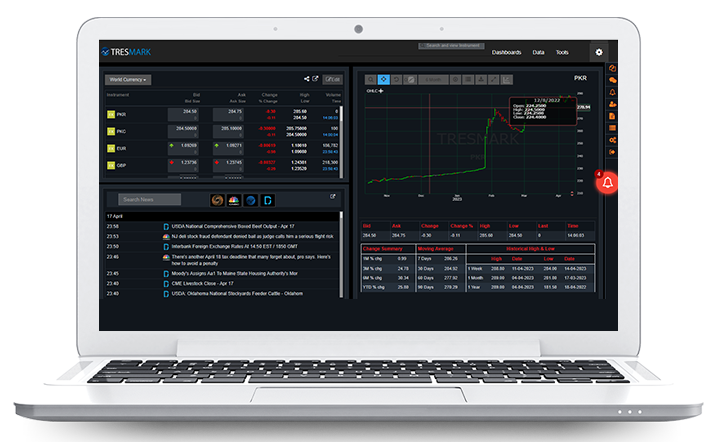
The Only Financial Information Platform You Need
Tresmark is the market leader, the only tool you need for a full picture od the financial markets




Galabetcasino is pretty cool! Lots of games and a decent user experience. Give it a try if you’re looking for something new! Visit here: galabetcasino
Sekabettr’s got a pretty good selection of sports betting options, I gotta say. Found some decent odds too. If you’re into sports, give it a shot. My experience with Sekabettr has been quite good, and I believe many other sports enthusiasts will agree. Try it yourself: sekabettr
Brazino777bonus, now that’s a name that screams bonuses! Seriously though, they always seem to have some kind of offer going on. Worth checking out if you like a little extra something-something. Don’t miss out on the fun, here’s the link: brazino777bonus