- March 18, 2026
- Posted by: Tresmark
- Category:
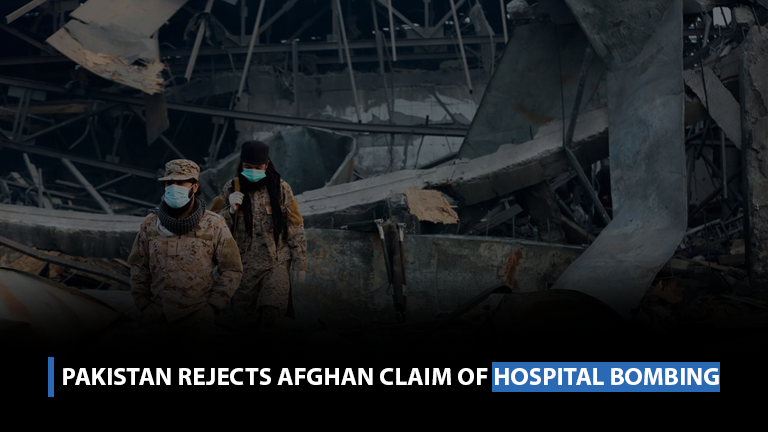
Information and Broadcasting Minister Attaullah Tarar Tuesday rejected the Afghan Taliban regime’s peddling yet another falsehood by alleging that Pakistan targeted a drug rehabilitation hospital in Kabul. This claim is entirely baseless, he said.
In a statement, the minister emphasised that Pakistan, in its ongoing war against terrorism, is engaging only those military and terrorist targets, along with the infrastructure of the Afghan Taliban regime, that are being directly or indirectly used to plan, facilitate, shelter, train, or abet terrorist attacks inside Pakistan.
The strikes carried out on the night of March 16 in Kabul and Nangarhar, he underlined, were precise, deliberate and professional. “No hospital, no drug rehabilitation centre, and no civilian facility was targeted. The targets were military and terrorist infrastructure, including ammunition and technical equipment storage sites and other installations linked to hostile activity against Pakistan,” he stressed.
As with established practice, he noted, all six strikes were promptly put out with video footage by the Ministry of Information and Broadcasting, making the nature of the targets plain for all to see. The visuals leave no room for doubt. The flames and secondary detonations witnessed in Kabul further confirm that the intended ammunition storage site was hit with precision.
The minister said that the current propaganda is coming from a regime whose officials have repeatedly relied on false narratives, doctored claims, selective deletions of earlier posts, and the circulation of old visuals to mislead audiences and cover up the truth. Their latest allegation is part of the same worn-out pattern of deceit, he added.
Tarar maintained that the real issue remains unchanged: Pakistan, the region and the wider world continue to face the grave threat of terrorism emanating from territory under the control of the Afghan Taliban regime. That threat has become even more barbaric, with drug addicts and innocent children being exploited for heinous purposes, including suicide bombings.
“Pakistan’s position is clear. We will continue to take every necessary measure to defend our citizens, degrade terrorist capability, and deny safe haven to those who wage terror against Pakistan from across the border,” he concluded.

The Only Financial Information Platform You Need
Tresmark is the market leader, the only tool you need for a full picture of the financial markets
Earlier Afghanistan’s Taliban regime alleged that Pakistan bombed a hospital in Kabul, killing at least 408 people and injuring 265.
Hamdullah Fitrat, deputy spokesman for the Taliban government, claimed that Pakistani forces bombed Omid Hospital, a 2,000-bed drug rehabilitation facility in the Afghan capital.
“The bombing killed 408 people and injured 265,” Abdul Matin Qani, spokesperson for Afghanistan’s Interior Ministry, alleged.
Meanwhile, spokesperson for the UN High Commissioner for Human Rights (OHCHR) Thameen Al-Kheetan, in a statement said that blast at a drug rehabilitation centre in Kabul must be investigated promptly, independently and transparently, and those responsible held to account in line with international standards. Those results must be made public. Victims and victims’ families are entitled to reparations.
Under international humanitarian law, civilians and civilian objects are strictly protected. The laws of war clearly spell out that any attack must comply with the fundamental principles of distinction, proportionality and precautions. International humanitarian law provides for specific and increased protections for medical facilities.
UN High Commissioner for Human Rights Volker Türk reiterates his call on all parties to take effective measures to ensure the protection of civilians, in line with their obligations under international human rights law and international humanitarian law. He calls for an immediate end to hostilities, and for all parties to ensure humanitarian aid reaches those desperately in need.
Separately, World Health Organisation (WHO) chief Tedros Adhanom Ghebreyesus said that WHO is working to verify last night’s incident, but the intensifying conflict is placing additional strain on health systems and increasing risks to the health and wellbeing of vulnerable populations.
“I urge all parties to de-escalate and prioritise peace and health. Peace is the best medicine.”
Meanwhile, China once again urged Pakistan and Afghanistan to exercise calm and restraint.
At a regular media briefing at the Foreign Office in Beijing, spokesperson Lin Jian confirmed that China is continuing its role as a mediator between the two neighboring countries.
He emphasied Afghanistan and Pakistan are neighbours that cannot be separated, and that dialogue and negotiation remain the only effective means to resolve their differences.
“China hopes both sides will remain calm, exercise restraint, engage in face-to-face communication as soon as possible, achieve a ceasefire promptly, and resolve their differences through dialogue”, Lin said.
He added China has urged both countries to ensure safety of Chinese personnel, projects, and institutions. China will continue to play a constructive role through its own channels to de-escalate tensions and improve bilateral relations.
Earlier, the issue was also discussed during a telephone conversation between Pakistan’s Foreign Minister Ishaq Dar and his Chinese counterpart Wang Yi. Pakistan assured China it attaches great importance to safety of Chinese citizens and assets and would make every effort to protect them, addressing concerns over terrorism and regional security.
Meanwhile, in a joint statement European Commission High Representative/Vice President Kallas and Commissioner Lahbib said that escalation between Pakistan and Afghanistan needs to end as soon as possible.
“We call on both sides to exercise maximum restraint and take all feasible measures to minimise the risk of harming civilians,” they said.
The EU joins calls by the international community for an immediate ceasefire and a resumption of dialogue between Pakistan and Afghanistan’s de facto authorities.
Meanwhile, at United Nations Security Council, Pakistan commended China for its role as a “pen holder”, describing its efforts as sincere.
These remarks were made by Ambassador Usman Jadoon, Deputy Permanent Representative of Pakistan to United Nations.
He was speaking during adoption of a resolution renewing mandate of United Nations Assistance Mission in Afghanistan (UNAMA) for three months, which was supported unanimously by all 15 members of the Council.
The United Nations Security Council on Monday unanimously extended the UNAMA mandate for three months, with all 15 members, including Pakistan, backing the move as Islamabad flagged a surge in cross-border terrorism from Afghan soil.
Speaking at the adoption of the resolution on the mandate renewal of Unama, Ambassador Usman Jadoon said Pakistan supported the three-month extension.
The Only Financial Information Platform You Need
Tresmark is the market leader, the only tool you need for a full picture of the financial markets
The UNAMA is a UN special political mission headquartered in Kabul, tasked with assisting people of Afghanistan, with liaison offices in Pakistan and Iran.
Highlighting a surge in cross-border terrorism, Jadoon stated Pakistan has consistently maintained foremost challenge in Afghanistan is deteriorating security situation and exponential rise in terrorism originating from its territory.
He alleged elements within the Taliban regime are actively collaborating with or providing a permissive environment to militant groups, including TTP, BLA, Majeed Brigade, Daesh-K, al-Qaeda, and ETIM. These groups, he said, operating with impunity and are responsible for cross-border attacks on Pakistani civilians, law enforcement personnel and critical infrastructure.
Referring to resolution, he noted the Council expressed concern over terrorist groups that continue to threaten international peace and security and called on the Taliban to take immediate, concrete and demonstrable action against terrorism.
He also stressed importance of safe and secure management of weapons and ammunition to prevent them from falling into the hands of such groups.
Regarding UNAMA’S role, Jadoon said the mission must monitor and analyse security dynamics, improve understanding of illicit economy, support efforts to curb illegal arms flows, and help create conditions for refugee reintegration.
He also warned against disinformation by local Taliban elements, stating it is obstructing UNAMA’s access across the country. At the same time, he emphasised the mission should report objectively, taking into account concerns of Afghanistan’s neighbours.
Pakistan expressed hope next three months would allow a review of UNAMA’s role in a way that supports long-term peace and stability in Afghanistan — “at peace with itself and its neighbours”.
In another development, Pakistan’s Permanent Representative to United Nations, Ambassador Asim Iftikhar Ahmad, speaking at the commemoration of International Day to Combat Islamophobia as Chair of OIC Core Group, criticised India for what he described as disrespect towards the OIC.
He stated India’s attitude reflects arrogance and a “malicious and convoluted mindset”.
“It was expected India would join us in condemning Islamophobia and brief participants on steps to alleviate suffering of millions of Muslims and other religious minorities affected by extremist Hindutva ideology. Instead, it deflected the issue and politicised the debate”, he said.
He added this undermines global efforts to combat Islamophobia and is a disservice to its victims.
The ambassador further stated India has become the world’s largest Islamophobic state, where such actions are not limited to fringe elements but occur under state patronage.
Citing 17th OIC Report on Islamophobia, he said India accounts for majority of documented Islamophobic incidents globally. He also referred to restrictions on Friday prayers in Srinagar during Ramazan and other incidents such as mob lynchings and destruction of mosques.
Pakistan called on India to take concrete action against Islamophobia and hold perpetrators accountable, emphasising progress should be measured through actions rather than rhetoric.