- March 7, 2026
- Posted by: Tresmark
- Categories:
Tresmark: Key Takeaways
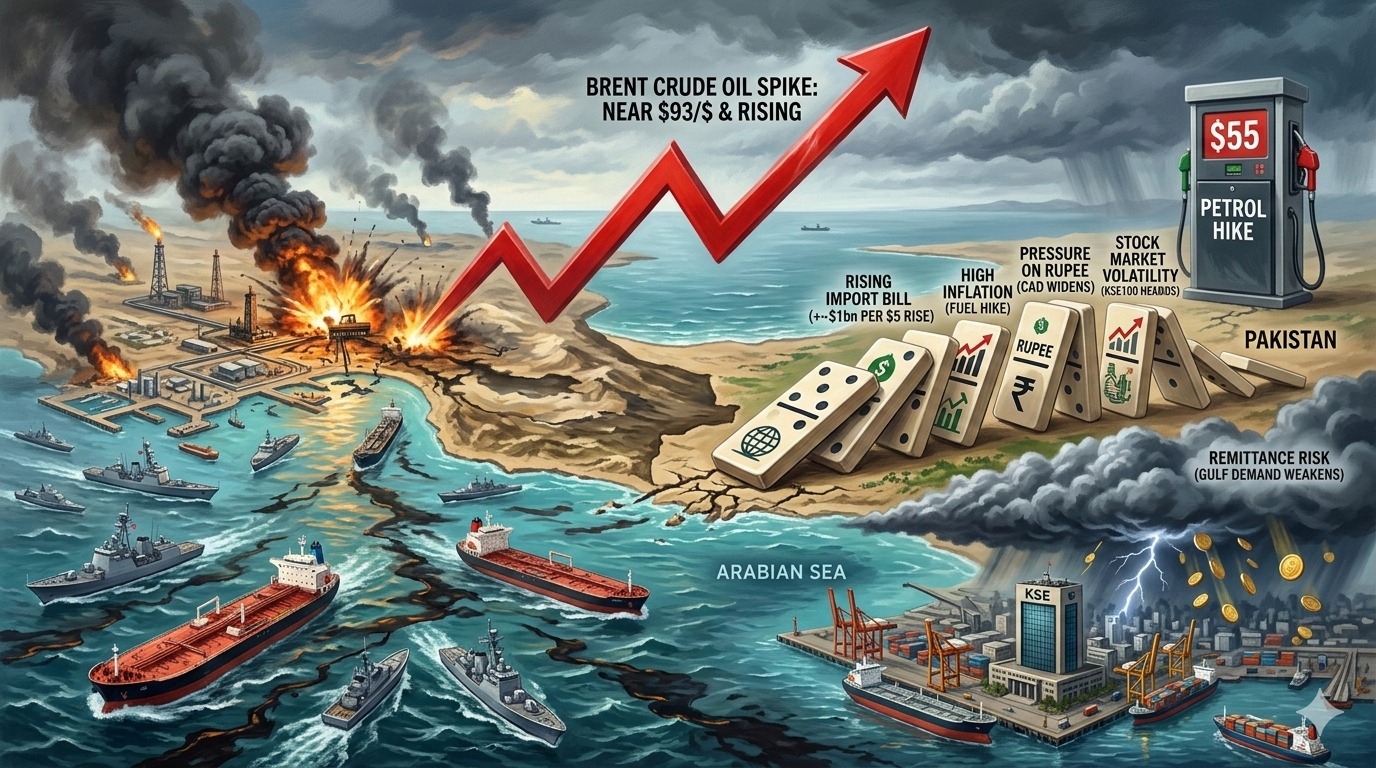
- Oil shock: Brent near 93/$; every $5 rise adds ~$1bn to Pakistan’s import bill, pressuring the current account.
- Rupee: Short-term USDPKR likely range-bound, but prolonged conflict could widen CAD and force tighter import controls.
- Interest rates: Rs55 petrol hike creates an inflation shock; SBP unlikely to cut rates soon, with upward pressure on yields.
- Remittances: Near-term inflows may hold up due to precautionary transfers and Eid season, but Gulf job demand could weaken if the war lasts >2–3 months.
- Equities: KSE100 facing headwinds from higher energy costs, rising yields, and weaker demand.
- Base case: Conflict likely contained within 3 months, keeping macro damage manageable.
Oil Shock: What the US–Iran Conflict Means for Pakistan
How do you navigate a whopping 30% increase in oil prices in a week? For perspective, Brent closed around 93/$ yesterday.
Oil prices are the pulse of global sentiment
Oil Is the First Transmission Channel. For Pakistan, this matters immediately. Oil remains one of the country’s largest import items, meaning price spikes quickly feed into the current account, inflation, and fiscal pressure.
A simple rule of thumb illustrates the scale. Every $5 increase in Brent crude adds roughly $1 billion to Pakistan’s annual import bill.
Another emerging risk is logistical. If tanker traffic through Hormuz slows, Gulf producers could hit onshore storage limits and be forced to shut down production temporarily, turning a shipping disruption into a genuine supply shock.
In other words, if this conflict extends beyond 2–3 months, it becomes a macro shock for Pakistan’s economy.
How Long Will the Conflict Last
Much of the market outlook now depends on how long the conflict lasts. If it remains contained within 2 months, the global economy is likely to return to its previous trajectory. But if it extends beyond 3 months, the damage could leave deeper scars through higher energy prices, tighter financial conditions, and weaker global demand. Anticipating the duration of the conflict has therefore become critical for markets.
At the start of the war, most commentators expected the conflict to last less than 4 weeks. As tensions widened into the GCC region, and with Iran showing deeper resilience and continued retaliation, that expectation has gradually shifted toward a longer confrontation.
Trump’s “unconditional surrender” demand was also interpreted by markets as a hardening of the conflict, triggering a late surge in oil and gold, while equities weakened.
Our base case, however, remains that the conflict will not extend beyond three months.
Several factors support this view.
- GCC states are likely to exert increasing pressure on Washington to contain the conflict, given how vulnerable they are.
- A sharp spike in oil prices would quickly create political pressure in the United States. Qatar’s energy minister has already warned that oil could reach $150 per barrel if supply disruptions occur. Such a scenario would complicate the Trump administration’s efforts to manage inflation and growth.
- The financial cost of a prolonged war would require sustained budget approvals and political backing, which may become difficult to maintain.
- Domestic support within Israel appears more muted compared to last year’s conflict, reducing the appetite for a prolonged campaign.
- A war extending beyond 2–3 months would require extensive coordination of stockpiles, logistics, and military resources, raising operational complexity for all sides.
Taken together, these factors lead us to believe that while the conflict may remain volatile in the near term, it is unlikely to extend beyond 3 months.
Markets are currently pricing escalation, but geopolitics often resolves faster than markets expect.
Oil Scenarios: How the Conflict Could Evolve
Three possible oil price paths depending on how the conflict develops.
Limited Conflict Oil around $80/barrel
Inflation rises modestly and global growth slows slightly. Central banks remain cautious but avoid major policy shifts.
Intensified Attacks on Energy Infrastructure
Oil around $108/barrel Inflation rises sharply. Bloomberg estimates this scenario could add 0.8 percentage points to global inflation, pushing it above 3%, well beyond the Fed’s 2% target. Rate cuts would likely be delayed.
Ceasefire Scenario
Oil falls toward $65/barrel. Inflation pressures ease and global markets stabilise.
Markets are already embedding a geopolitical risk premium of roughly $5–$15 per barrel, reflecting higher shipping insurance costs and disruption risks in the Strait of Hormuz.
For Pakistan, the economic pressure becomes most visible in the $80–$108 range, where the oil bill rises sharply and inflationary pressures intensify.
Remittances: Short-Term Support, Long-Term Risk
Pakistan receives roughly 55% of its remittances from the Gulf region. In the short term, geopolitical uncertainty can actually increase remittance inflows, as overseas workers send precautionary transfers home. The next 3 months will consist of two Eids, during which remittances are historically high.
But the longer the conflict persists, the more risks emerge. If tensions extend beyond 2–3 months, construction activity and other employment opportunities in Gulf economies could slow. This matters because a large share of Pakistani workers in the region are employed in construction and related sectors. This will also feed into the current account equation.
The longer the conflict lasts, the harder it becomes for Pakistan to avoid the economic ripple effects.
How Will Rupee Perform
Most peer currencies weakened last week. The Egyptian pound fell nearly 5%, while the Indian rupee touched an all-time low of 92.58/$. In contrast, the Pakistani rupee firmed slightly by about 5 paisa.
In the near term, we expect USDPKR to remain range-bound, although import premiums may edge higher. Over the medium term, however, the outlook depends heavily on how the conflict evolves. A prolonged conflict could deteriorate the current account, primarily due to higher oil payments, lower remittances, and trade disruptions linked to the Pak-Afghan conflict, and force the central bank to ration fresh import LCs to preserve foreign exchange liquidity.
Tighter import controls and potentially higher interest rates would likely slow an already muted GDP growth outlook.
Global Markets: Inflation Is Back on the Radar
Higher oil prices are already feeding into global inflation expectations. If oil reaches $108, Bloomberg estimates global inflation could rise above 3%, forcing central banks to remain cautious about easing monetary policy.
At the same time, US 10-year Treasury yields have risen about 18 basis points, now trading above 4.14%, reflecting rising inflation expectations and geopolitical risk.
Higher US yields matter for Pakistan because they:
- increase global borrowing costs
- strengthen the US dollar
- put pressure on emerging-market currencies
For Pakistan, this means higher external financing costs and additional pressure on the rupee.
What the Petrol Bomb Means for Pakistan’s Interest Rates
A major Rs55 petrol hike will trigger a significant inflation shock and a blow to corporate margins. Analysts expect CPI to increase by 3% by June.
The latest T bill auction and trades in the secondary market reflect this shift, with cut-off yields rising 20–40 basis points, signalling expectations of renewed policy tightness. The increase in yields is also reflective of rising sovereign risk, with 5-year Pakistan CDS rising by 20 bps last week.
Most market participants are of the view that SBP will not rush into a rate hike and that Monday’s Monetary Policy meeting will remain unchanged, but they expect a hike in the following meeting (April 27th) if the conflict continues. Some analysts also expect an emergency monetary policy meeting if petrol prices see further increases.
The Bigger Risk: Global Stagflation
If the conflict drags on, economists warn about the risk of stagflation — slower growth combined with higher inflation. Such an environment would weaken global demand and could eventually affect Gulf economies, where millions of Pakistanis are employed.
If that happens, Pakistan would feel the impact through:
* higher oil import costs
* slower remittance growth
* tighter global financial conditions
A stronger US dollar and elevated global interest rates would further increase borrowing costs and pressure the rupee.
KSE100 Facing Headwinds
The current conflict is materially different from last year’s episode. Previously, tensions did not spill into the GCC, the Strait of Hormuz remained open, and Brent never surged by 30% as it has now.
If the conflict extends beyond 2–3 months, the cumulative impact of higher business costs, weaker demand, and elevated interest rates could begin to dent the equity market. In other words, while the fundamentals of the market remain intact, the environment is turning more challenging.
In the coming week, additional selling pressure is likely, particularly after the Rs55 fuel price hike and its downstream effects on inflation, corporate margins, and higher yields.