- February 20, 2026
- Posted by: Tresmark
- Category:
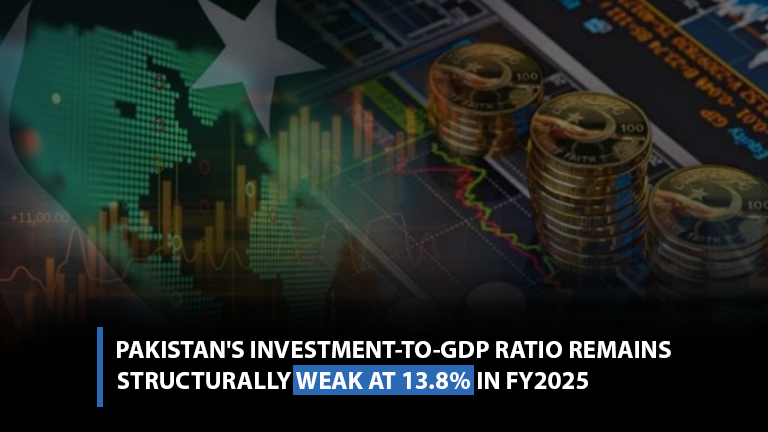
Bangladesh had a turbulent 2025, yet its investment-to-GDP ratio stood at 22.4% — still far above Pakistan’s 13.8%, which has failed to regain even its FY2022 peak of 15.6%. Regional peers such as India and Vietnam continue to sustain investment levels above 30%, underscoring Pakistan’s persistent position as the lowest-investing major economy in Asia.
Although the current hybrid and multiparty setup has achieved macroeconomic stability, it has clearly failed to improve investor sentiment and investment outcomes.
Industry leaders say structural barriers remain largely unaddressed despite the creation of a high-level investment facilitation council intended to streamline approvals. Although improving, executives report that establishing an industrial project still requires roughly 25 regulatory permissions across federal and provincial agencies, prolonging timelines and raising uncertainty.
Senior corporate executives privately acknowledge frustration with the performance of the investment facilitation council, which was designed as a single-window platform to cut red tape. While its leadership is widely viewed as disciplined and execution-oriented, business representatives argue that the same rigidity has constrained innovation in investment strategy.
“Discipline has delivered many achievements in human progress, but it can also discourage new thinking,” said a business association official familiar with investor outreach.
Pakistan has largely continued offering conventional, legacy project ideas to global investors, securing memoranda of understanding rather than binding investment agreements. Analysts say proposals have often centred on traditional sectors such as conventional oil refining, even as major energy producers — such as KSA and the UAE — are themselves shifting toward diversified and renewable-linked industries, limiting Pakistan’s competitiveness in attracting modern industrial capital.
“Pakistan’s investment ratio is structurally disconnected from the region,” said Maryam Ayub, Research Economist at the Policy Research Institute of Market Economy (PRIME). “Even economies facing shocks maintain much higher investment than Pakistan, which indicates deep domestic constraints rather than temporary weakness.”
Pakistan’s investment-to-GDP ratio declined from 15.6% in FY2022 to 13.1% in FY2024 before only marginally recovering to 13.8% in FY2025. India sustained investment around 32-35% of GDP during the same period, while Vietnam remained near 30-33% and Bangladesh historically near 30% despite its 2025 dip.
The Only Financial Information Platform You Need
Tresmark is the market leader, the only tool you need for a full picture of the financial markets
Economists say the sub-15% level effectively caps Pakistan’s growth potential far below regional peers. Asian economies that achieved sustained industrialisation typically maintained investment above 25-30% of GDP, enabling productivity gains and export expansion.
“If stabilisation were restoring investor confidence, investment would be rising decisively. Instead, it remains stuck near historic lows,” said the PRIME economist.
Credit allocation patterns help explain the stagnation. Banking data for 2025 shows government borrowing dominating credit flows throughout the year, ranging between roughly Rs30 trillion and Rs36 trillion per month, compared with only Rs9.5-10.9 trillion for the private sector.
At several points, sovereign borrowing exceeded private credit by more than three times, a scale economists say reflects entrenched fiscal dominance rather than cyclical crowding-out.
“Banks prefer lending to the government because it is risk-free and profitable,” Ayub said. “That keeps banks healthy but leaves industry underfinanced.”
Rising domestic debt has reinforced the pattern, as the state absorbs banking liquidity to finance deficits instead of enabling productive investment.