- March 14, 2026
- Posted by: Tresmark
- Category:
Tresmark: In April 1815, people living near Mount Tambora, Indonesia, believed the world was ending. The earth trembled for days before an explosion so violent it was mistaken for cannon fire. Ash fell like black rain, villages vanished within hours and daylight itself seemed to disappear. There was no summer that year.
The deeper impact was felt far away. Crop failures spread across Europe and Asia with food prices doubling and famine like conditions in some parts of France. Inflation surged and economies weakened.
Most people who suffered never saw the mountain, yet they lived through its consequences. Something similar may now be unfolding. The shock is elsewhere, but the economic aftershocks are everywhere.
For Pakistan, the question is not whether this matters. It is how and when.
We had indicated earlier that if this war stretches beyond a 2 to 3 month window, the consequences for Pakistan could become meaningful. It has already been 15 days and there are still no visible signs of an off ramp or credible ceasefire path.
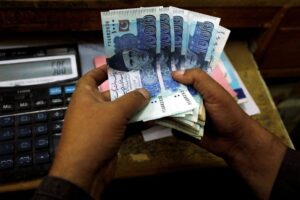
Against this backdrop, the most frequent question we are getting is how the Rupee is likely to behave.
Short term
In the near term, Ramadan related remittance inflows remain healthy. FX forward premiums are trading above money market levels, signalling comfortable forex liquidity. News flow from IMF MoF engagements is also broadly constructive.
Over the last two weeks, export related inflows have slowed somewhat. At the same time, there appears to be a deliberate effort to stagger import payments so that the interbank market remains broadly square on any given day. This approach should continue to deflect undue pressure on Rupee parity.
Taken together, this suggests that the Rupee is likely to remain range bound over the next few weeks. Two notable cash flow pressures lie ahead. A heavy oil payment cycle immediately after Eid and more than $1bn required for upcoming Eurobond repayments.
Medium term
This is where the outlook becomes much less clear
The New Oil Regime
The Strait of Hormuz has effectively become a pricing mechanism.
Markets are now trading probabilities of disruption rather than actual supply loss, which makes oil structurally more volatile. It is behaving less like a commodity and more like a strategic asset.
This creates a new macro environment:
– Persistent energy inflation risk
– Volatility spikes unrelated to demand cycles
– Structural uncertainty in global trade flows
The Remittances Conundrum
Remittances have quietly kept Pakistan afloat through every crisis. That cushion now looks less certain. If Gulf economies stall, labour demand will naturally soften. Fewer workers abroad mean weaker inflows and rising pressure at home. It is a slow burn risk, not dramatic in headlines, yet powerful enough to reshape Pakistan’s macro trajectory.
Global market conditions
Global financial conditions are likely to tighten as geopolitical risk premia are reintroduced into emerging market pricing. Pakistan’s Eurobond yields and CDS have already widened by around 100 bps, signalling a shift in external investor perception.
This raises the cost and uncertainty around market based financing. Access to Eurobond or Panda bond markets may become more challenging, while FDI and portfolio inflows could remain constrained. The external financing mix therefore becomes more dependent on policy credibility and multilateral engagement.
Impact
Both these forces have the potential to widen the current account deficit, increase fiscal strain and reduce policy flexibility. As inflation expectations begin to adjust, interest rates are likely to remain higher for longer. The currency comes under renewed pressure and growth momentum weakens. The cumulative effect can be significantly damaging
Base case
Pakistan is unlikely to burn through reserves to defend the Rupee. The adjustment will instead come through tighter import management and a shift towards a more sustainable external balance. The Rupee may depreciate gradually over time, but at this stage we do not expect any abrupt or step devaluation.