- June 23, 2026
- Posted by: Tresmark
- Category:
No Comments
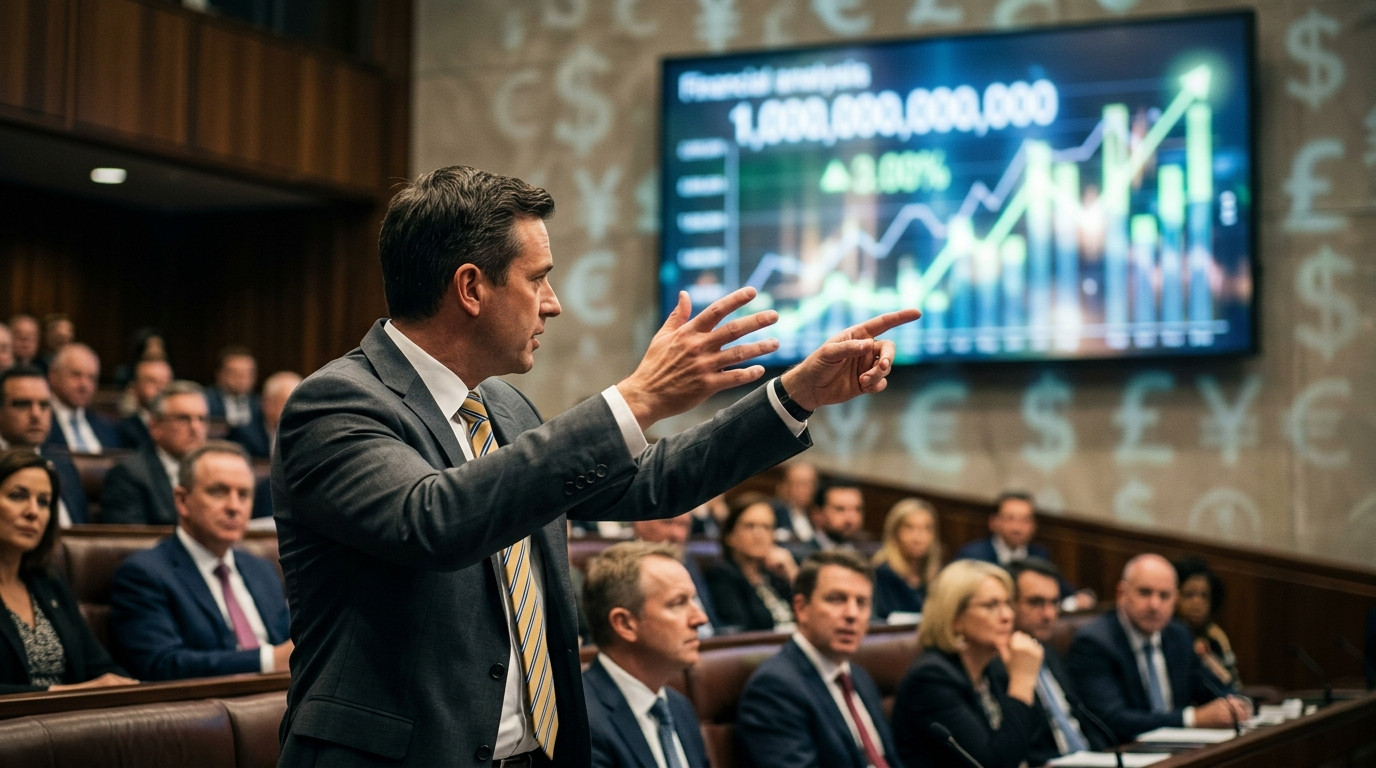
The National Assembly on Monday completed approval of all 135 demands for grants worth approximately Rs10.4 trillion relating to various ministries, divisions and departments for the upcoming financial year 2026-27, while rejecting 587 cut motions moved by opposition members.
The lower house on Monday gave nod to 10 demands for grants for the Ministry of Interior and Narcotics, National Food Security and Research, and Poverty Alleviation and Social Safety Division and attached departments.
Earlier, the National Assembly on Sunday had approved 125 demands for grants of various ministries, divisions and attached departments for the upcoming fiscal year starting July 1, 2026.
The National Assembly will pass the federal budget (Finance Bill, 2026) on Tuesday (today). The House on Monday approved three demands for grants worth Rs33.70 billion for the Ministry of National Food Security and Research after rejecting 112 cut motions moved by opposition lawmakers.
According to details, the approved allocations included Rs22.232 billion for the National Food Security and Research Division, Rs7.291 billion for the Pakistan Agricultural Research Council (PARC), and Rs4.183 billion for development expenditure of the National Food Security and Research Division.
The National Assembly also approved three demands for grants worth Rs859.976 billion for the Poverty Alleviation and Social Safety Division while rejecting 45 cut motions moved by opposition members.
The approved allocations include Rs806 million for the Poverty Alleviation and Social Safety Division, Rs844.78 billion for the Benazir Income Support Programme (BISP) and Rs14.39 billion for Pakistan Bait-ul-Mal.
For the Interior and Narcotics Control Division, demands for grants worth Rs2665 billion, Rs23.125 billion and Rs21.824 billion were okayed. The House also granted approval to Rs23.221 billion for the Islamabad Capital Territory.
Barrister Gohar Ali Khan, while taking part in discussion on a cut motion earlier, said that the Ministry of Interior has an important role in maintaining rule of law, but he regretted that there has been worst violation of human rights and law in the last four years.
He said the opposition always talks about rule of law in the country while the Pakistan Tehreek-e-Insaf (PTI) is always endeavouring for the same. Barrister Gohar said the opposition leader himself shook hands with the prime minister and it was expected that the political atmosphere would improve.
But, he regretted that Dr Yasmin Rashid and Ejaz Chaudhry have been convicted again. “PTI is not against punishments but not on the basis of fabricated cases,” he said. The PTI chairman said they have stated time and again that the dust of May 9 should now settle down and the process of political victimisation should come to an end.
Another PTI lawmaker also raised questions on the performance of the Ministry of Interior. “Funds of the Ministry have been raised but it should also improve its performance,” he said, adding that the interior minister has now been given the charge to destroy cricket in the country.
Jamiat Ulema-e-Islam-Fazl member Noor Alam, while referring to a case of Pinky, suggested drug traffickers should be handed capital punishments as they were playing with lives of young students. “I have withdrawn my seventh-class son from a school in Peshawar after I came to know that students were using ice there,” he said.
PTI’s Ali Muhammad Khan also criticised the Ministry of Interior, saying that it was meting out step-motherly behaviour towards citizens. He questioned as to where the interior minister came from to the corridors of power. “We can only talk to political people to find a solution to political matters,” he said.
Defence Minister Khwaja Asif suggested that the Ministry of Interior should compile a list of users of bulletproof vehicles and it should also be seen what the source of money to change costly tyres is.
He said that the number of bulletproof vehicles was on the rise in the country. Federal Minister for Finance and Revenue Muhammad Aurangzeb presented the demands for the next financial year.
Responding to points raised by opposition lawmakers, Federal Minister for National Food Security and Research Rana Tanveer Hussain said the agriculture sector remains a top priority of the government under the leadership of the prime minister, adding that it is believed to be the key driver in turning around the country’s economy.
He said it was regrettable that opposition members had not raised demands for increased funding for the sector, which he termed the backbone of the national economy. He added that duty-free machinery had been allocated in the current budget on the directions of the prime minister.
The minister said agriculture is a devolved subject under the 18th Constitutional Amendment, while food security remains a federal responsibility and agricultural research. Minister of State for Interior Talal Chaudhary said the government has significantly strengthened its immigration and passport verification system, resulting in a 47 percent reduction in illegal migration from the country to various destinations worldwide.
He said arrangements are being made to ensure that the passport facility is also available at Nadra offices. Talal Chaudhry stated that the federal capital will become Pakistan’s first smart city, featuring a comprehensive e-governance system aimed at delivering efficient civic services to the people.
Minister for Poverty Alleviation and Social Safety Syed Imran Ahmad Shah said that the government is providing education and healthcare support to deserving families under the BISP. He added that special priority is being given to Balochistan.
The minister said a digital wallet system has been introduced to ensure transparency in the disbursement of BISP payments. Similarly, Pakistan Bait-ul-Mal has also been digitised.
Meanwhile, Minister for Law and Justice Azam Nazeer Tarar on Monday urged opposition lawmakers to actively participate in parliamentary committees and the legislative process instead of merely criticising the government.
He said representatives of the Ministry of Law and Justice had repeatedly requested members to attend meetings, but some lawmakers had chosen not to participate.
Tarar also informed the House that the government had introduced a comprehensive package of around 100 amendments to criminal laws, which is currently under consideration by the relevant standing committee.
He urged lawmakers to engage in committee deliberations and contribute to legislative reforms. He said the government was still awaiting feedback from the Khyber Pakhtunkhwa government on the proposed amendments, which he termed non-political in nature.
He stressed that strengthening the rule of law requires practical participation in legislative work rather than speeches alone.
Talking about judicial matters, the minister said court proceedings and convictions are decided by the judiciary and not by the government, adding that anyone with objections to convictions could seek relief through the appellate process.
Source: The International News Pakistan