
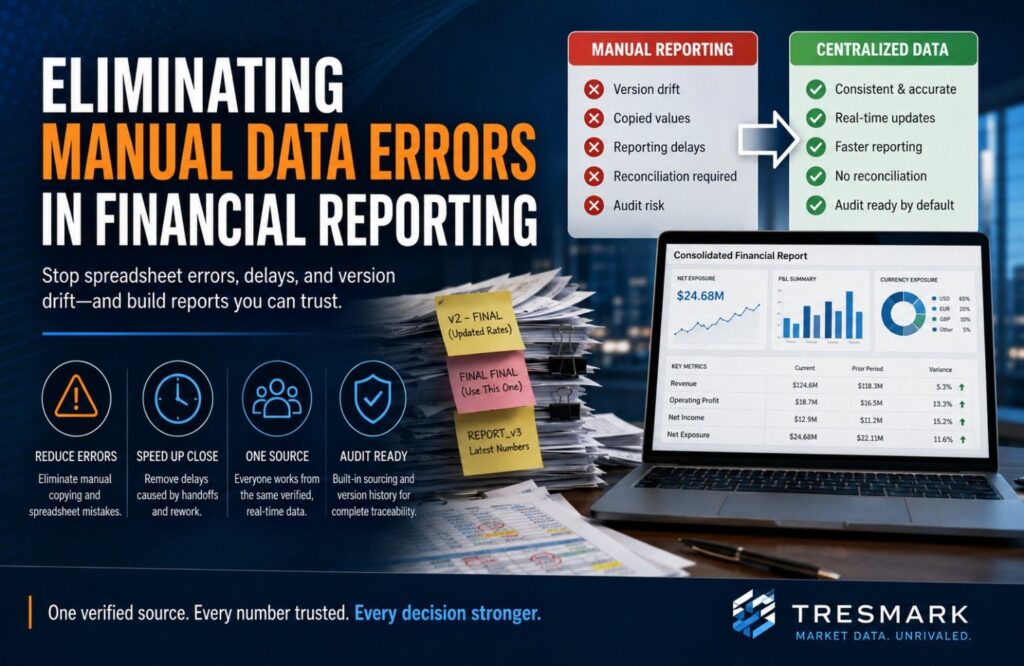
Why Reporting Errors Rarely Start as Major Problems
A finance team running month-end close does not usually encounter a single large error. What it encounters is a series of small adjustments, each individually defensible, that quietly compound across the reporting cycle.
Someone updates a rate manually because the feed has not refreshed yet. A colleague copies last week’s export into a new template and adjusts two figures. A third person adds a line item that was missing from the consolidated file. None of these actions are wrong in isolation. Each one introduces a variable that the next person in the reporting chain has to account for, usually without knowing it is there.
The compounding happens silently. A figure adjusted in one sheet does not automatically update in the three other places it appears. An export rebuilt from a platform carries the values current at the time of the export, not at the time the report gets reviewed. By the time the consolidated numbers reach sign-off, they reflect a combination of when each input was pulled, who last touched it, and what manual corrections were applied along the way.
What makes this hard to catch early is that the reporting process continues functioning normally throughout. Files get produced. Numbers populate. Reports go out on schedule. The errors are not visible at the workflow level. They live inside the figures themselves, and they only surface when someone compares outputs across departments or when an external reference produces something different.
At that point the question is never just what went wrong. It is how far back the discrepancy runs.
How Spreadsheet-Based Reporting Starts Creating Version Drift
Reporting data consistency does not break down because teams are careless. It breaks down because the same data exists in multiple places, maintained independently, with no mechanism keeping versions aligned.
A reporting template gets shared across three team members. One updates the currency assumptions on Monday morning. Another works from a downloaded copy saved the previous Friday. A third pulls figures from an export that predates both. All three are working from files with the same name, the same structure, and different numbers.
Version drift does not require negligence. It requires only that multiple people handle related data independently, which is how most reporting workflows are built.
Where Copied Values Introduce Errors
Spreadsheet reporting errors enter the reporting chain most consistently through manual copying:
A rate rounded to two decimal places in one sheet gets carried into a calculation built for four
A figure copied from a platform export picks up formatting that changes its value when pasted into a formula
A prior period adjustment copied forward as a placeholder never gets updated before the report goes out
A consolidated file rebuilt from individual team exports reflects whichever version each team happened to save last
Each instance is minor. Across a full reporting cycle involving multiple teams and multiple data sources, the cumulative effect on reporting data consistency is significant enough to require a reconciliation pass before any consolidated figure can be trusted.
When the underlying inputs vary by source, manual copying carries two layers of risk simultaneously. Formatting errors from the copy process itself, and source variance from the data that was copied.
Where Reporting Delays Begin
Manual handling does not just introduce errors. It introduces waiting.
A reporting cycle that depends on exports, copied values, and individually maintained files has a delay built into every handoff. One team finishes its section and sends it to the next. The next team checks the figures against its own source before incorporating them. If something does not match, the file goes back. The cycle restarts from the point of the discrepancy.
That back-and-forth is not a failure of process design. It is the process working as intended in an environment where figures cannot be trusted without verification. The delay is the cost of operating without a shared data reference.
Approval chains absorb the same friction further up. A CFO or finance director reviewing a consolidated report before sign-off cannot approve figures that two departments are still reconciling. The approval waits. Not because the decision is complicated but because the inputs feeding it have not been confirmed.
How Delays Stack Inside a Reporting Cycle
The individual delays are small. The cumulative effect is not:
An export pulled four hours before the market close reflects conditions that have since moved
A manual adjustment made to compensate for a stale figure introduces a new variable the next reviewer has to account for
A consolidated file waiting on one team’s input holds up the entire reporting chain
An approval delayed by one reconciliation cycle pushes the next reporting deadline closer
Reporting lag accumulates at every handoff point where a figure needs human confirmation before it can move forward. In a manual reporting environment, those points are everywhere.
Access bottlenecks in the underlying data infrastructure contribute directly to this lag. How those bottlenecks develop across fragmented data environments is covered in common challenges in accessing reliable market data.
Why Teams Start Rechecking Financial Reports
Finding one discrepancy is usually enough. An analyst who caught a copied value error stops assuming reports are clean before they have been checked. No meeting, no formal decision. Just a change in how that person works from that point forward.
That behavior spreads the same way it did before the discrepancy was found. Quietly, without announcement, as individual habit rather than formal process.
A senior analyst who caught a copied value error six weeks ago now checks every consolidated file before passing it up. A finance manager whose team was asked to explain a variance in last quarter’s report now builds a comparison step into every cycle. Neither of them documents this. It just becomes part of how they work.
The operational cost sits in what rechecking displaces. An analyst spending forty minutes verifying inputs before starting the actual analysis is not being inefficient. The environment is. The verification is a rational response to a reporting infrastructure that has demonstrated it cannot be trusted without it.
Inconsistent market data feeding into manual reporting workflows is one of the most common triggers for this behavior. When the underlying inputs vary depending on which source a team used, rechecking the report does not resolve the problem. It just confirms the discrepancy exists before it reaches someone senior enough to ask about it. That dynamic is covered in more detail in how inconsistent market data compounds across systems.
When Reporting Errors Start Affecting Financial Decisions
Reporting errors that stay inside the reporting team are an operational problem. The ones that reach decision-makers are a different category entirely.
Exposure figures presented to leadership in a treasury review pass through several manual steps before reaching the room. Each step handled carefully, each output checked before being passed forward. A rate pulled before the morning fix was published. A copied value carrying a rounding difference that compounded quietly across the calculation. Nothing in the final report flags either of those things. The figures look complete because the process that produced them was followed correctly.
The decision gets made on those figures without anyone in the room knowing otherwise.
Procurement leadership negotiating annual supplier contracts faces a version of the same problem with different stakes. Internal cost assumptions built from manually maintained spreadsheets may reflect market conditions from the previous week, the previous month, or whenever the last export was pulled. A supplier quoting against current benchmarks is working from more current information than the team sitting across from them.
For finance leadership the problem surfaces most concretely at audit. A consolidated report without a clean version history, without sourcing attached to every figure, without a reliable record of what was adjusted and when, requires reconstruction before it can be reviewed. That reconstruction falls on the reporting team. It is not a sign-off delay. It is a separate body of work that exists only because the reporting process did not produce a traceable record the first time.
Tresmark’s reliable financial reporting data infrastructure removes the manual handling layer that introduces these errors, giving reporting teams a single verified source that carries a clean audit trail by default.
What Centralized Reporting Data Changes
Removing manual handling from the reporting chain does not just reduce errors. It changes how the reporting process itself is structured.
When every team pulls from the same verified source, the reconciliation step between departments disappears. Not because teams stop checking each other’s work but because the figures they are checking against are already the same. A treasury report and a procurement