
- April 15, 2026
- Posted by: Tresmark
- Category:
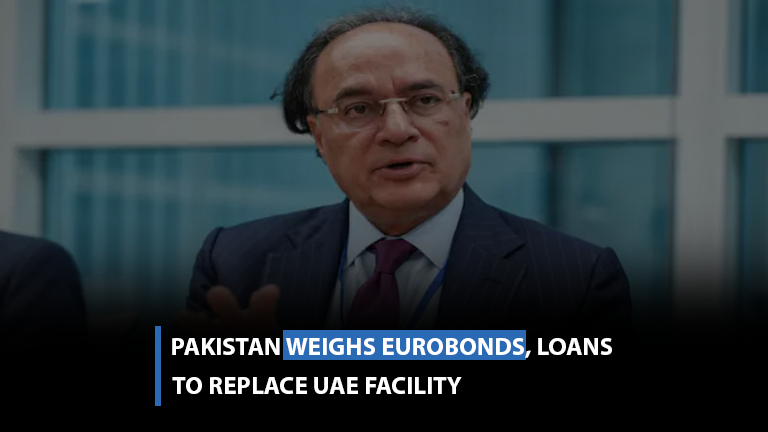
Pakistan is exploring a mix of international bonds, bilateral loans and commercial financing to shore up foreign exchange reserves and replace a maturing facility from the United Arab Emirates, Finance Minister Muhammad Aurangzeb said, as the economy grapples with the fallout from the Middle East conflict, reported Reuters.
Speaking on the sidelines of the IMF-World Bank Spring Meetings in Washington, Aurangzeb said “all options are on the table”, including potential support from countries such as Saudi Arabia, as Islamabad prepares to repay a $3 billion–$3.5 billion UAE loan that has not been rolled over for the first time in seven years.
A separate report by Bloomberg quotes the finance minister as saying that “whatever we need to cover will be a combination of many sources.” The minister pointed to commercial borrowing and bilateral partners while declining to provide further details on specific talks.
The repayment is expected to put pressure on Pakistan’s external buffers at a time when rising oil prices and broader supply disruptions linked to the Middle East conflict are weighing on the economy.
Aurangzeb said Pakistan’s foreign exchange reserves remain sufficient, the central bank’s reserves remain at roughly $16.4 billion, covering close to three months of imports — a level he described as critical for maintaining macroeconomic stability.
To strengthen buffers, the government plans to return to global debt markets this year after a four-year hiatus, with a pipeline that includes eurobonds, Islamic sukuk and dollar-settled rupee-linked bonds.
“We are looking at eurobonds, we are looking at Islamic sukuk, we are looking at dollar-settled rupee-linked bonds,” he said, adding that requests for proposals to appoint lead managers would be issued shortly.
In a meeting with IMF official Jihad Azour and the Fund’s Pakistan team, the minister expressed optimism about early board approval of the programme. Discussions covered the economic impact of the Middle East conflict and progress on fiscal and structural reforms, with both sides stressing the importance of maintaining macroeconomic stability.
On the sidelines, Aurangzeb also engaged with international media, outlining the government’s efforts to stabilise the economy, enforce fiscal discipline and attract foreign investment.
Pakistan is also preparing its first yuan-denominated Panda bond, with an initial $250 million issuance, part of a planned $1 billion programme, backed by the Asian Development Bank and the Asian Infrastructure Investment Bank.
Despite the external pressures, Aurangzeb expressed confidence in the country’s ability to meet its debt obligations, citing recent repayments including a $1.3 billion Eurobond.
“We’re very committed to pay and ensure there are other resources available to keep our reserves at the right place,” he said. The minister added that Pakistan has not yet sought changes to its $7 billion IMF programme in response to the oil shock, though this could be considered if conditions worsen. The Fund’s executive board is expected to approve the next tranche, unlocking about $1.3 billion, including support under the Resilience and Sustainability Facility.
The Only Financial Information Platform You Need
Tresmark is the market leader, the only tool you need for a full picture of the financial markets
Aurangzeb said the economic impact of the Middle East conflict, particularly higher energy costs, underscored the need for structural adjustments, including building strategic petroleum and liquefied petroleum gas reserves and accelerating the transition to renewable energy.
“When you go through a supply shock like this, it sends a very clear view that we need to accelerate these journeys,” he said.
Pakistan is projecting economic growth of around 4.0 per cent this fiscal year, supported by remittances of about $41.5 billion and targeted social assistance, which the government expects will help cushion the impact of external shocks.
Aurangzeb held talks with US Trade Representative Jamieson Greer, where both sides discussed expanding bilateral trade and improving market access. They noted progress in ongoing negotiations and reaffirmed a commitment to deepening economic cooperation.
In a meeting with World Bank Managing Director for Operations Anna Bjerde, the minister highlighted the lender’s support for Pakistan’s reform programme. Discussions focused on the economic fallout from the Middle East conflict, including spillover effects on growth and inflation, as well as the need to strengthen social protection. Progress under the World Bank’s Country Partnership Framework was reviewed, alongside calls for closer coordination between federal and provincial authorities on demographic challenges.
Aurangzeb also met Jonathan Greenstein, a senior US Treasury official, underscoring Pakistan’s recent staff-level agreement with the IMF and reiterating the government’s commitment to reforms. He pointed to the repayment of a $1.3 billion Eurobond as evidence of Pakistan’s ability to meet external obligations. Both sides discussed the potential impact of geopolitical tensions on remittances and foreign exchange reserves.
In discussions with IFC Managing Director Makhtar Diop, the finance minister stressed the need to scale up private-sector investment and job creation. He called for greater support in developing capital markets and deeper engagement in agriculture, while acknowledging the IFC’s role in mobilising local currency financing.
Talks with Saudi Fund for Development Chief Executive Sultan bin Abdulrahman Al-Marshad centred on ongoing development cooperation and the implications of Middle East tensions for global energy markets.
Aurangzeb also met World Bank Vice President Jorge Familiar Calderón, highlighting Pakistan’s efforts to diversify financing through instruments such as sukuk and ESG-linked bonds, and to expand access to international capital markets. He sought technical support to strengthen debt management capacity.
In meetings with Mastercard and Google executives, the minister emphasised digital transformation, including expanding financial inclusion, strengthening cybersecurity, and promoting artificial intelligence applications in sectors such as agriculture and manufacturing. He also welcomed Google’s plans to expand its presence in Pakistan. Separately, Aurangzeb held talks with the Multilateral Investment Guarantee Agency, which is considering a trade finance facility of up to $500 million to support essential imports. He urged swift progress on the proposal.


https://shorturl.fm/qtvCy
It is always a pleasant surprise to find an article that delivers exactly what it promises. Your objective breakdown of the facts is valuable and incredibly useful to read today.
fastest withdrawal online casino canada
I enjoy how this post combines easy wording and meaning in a way that keeps the discussion interesting, easy to follow, and open enough for readers with different viewpoints to participate comfortably in the conversation.
путин иди нахуй
Oopbuy Spreadsheet is a free shopping-agent spreadsheet and product finder for cross-border shoppers. The oopbuy spreadsheet ? aggregates thousands of curated finds — with photos, prices and working agent links — so buyers can compare items ? across popular Chinese shopping agents
Oopbuy Spreadsheet
This post creates a pleasant atmosphere for discussion by keeping the tone balanced and the content simple to understand.
casino en ligne visa